

Select Committee on Foreign Affairs Minutes of Evidence
Written evidence submitted by Adriana Stuijt
(a) In regard to the testimony submitted by Prof James Barber and Professor David Simon, 9 December 2004 in Public Questions 1-83: (New evidence submitted herewith)
(b) Video evidence: on unusually cruel nature of the farm attacks against owners of farm land;
I am submitting this video of a 2003 broadcast on the South African Broadcaster "Carte Blanche" programme; the contents of which were clearly unknown to Prof. Simon and Prof. Barber. This documentary by the award-winning documentary producer Susan Puren shows clearly that these farm attacks are not motivated by greed—frequently valuable articles such as jewellery are left behind on the scenes of these crimes. Their information that mostly "white" Afrikaner farmers were targeted also is highly inaccurate; many black owners of farm land also are murdered, often with their entire families, over land disputes mostly.
Our website, http://www.censorbugbear.com, has collected a large body of evidence in this regard over the past three years, submitted by journalists inside South Africa. The South African police has also published a new report on their website, http://www.saps.org.za, from the "independent commission of inquiry into the farm attacks" appointed by Pres. Mbeki. This information also seemed unavailable to your expert witnesses, even though it is freely available on the internet. Moreover, a complete list of names of farm attack murder victims, provided by the SA Police, is updated regularly on the following website; also run by unpaid volunteers in South Africa:
http://www.100megspop2.com/crimebusters/farmvictims.html
and also
http://groups.msn.com/crimebustrsofsouthafrica/farmvictims.msnw
Thus far, 1,591 farm dwellers have been killed in such armed attacks, people of all racial backgrounds who are being targeted by organised groups of young African men who often steal nothing at all. This violence is being described by a leading world expert on genocide, Dr Gregory Stanton of "Genocide Watch" in the US, as being in an advanced stage of genocide. Read his report on: http://www.genocidewatch.org/boersslain01.htm
*I am submitting these website addresses because I believe in not using to much paper. I hope that the Members of your committee will access these websites and download these reports themselves—and thus view these reports as written evidence submitted to your hearing.
The "Carte Blanche" programme may be further highlighted by the journalist Susan Puren who did all the interviews and research. Her email address is purens@lantic.net
The SA police farm attack report may be read online at: http://www.spas.gov.z2/farmat/index.htm
This investigation had also found that in certain cases, "the farm attacks are being carried out with considerably more violence than routine robberies elsewhere and that this is due to racial hatred". Futhermore, the illegal land occupations by the Landless People's Movement and other NGOs are on the increase and also lead to farm attacks and murders and "this was a matter of large concern", this independent report stated.
I apologise for this hand written submission but this is due to circumstances beyond my control.
Adriana Johanna Stuijt
January 2004
Biography:
Adriana Stuijt (often referred to as Ada Stuijt) was a Dutch-born journalist and activist whose life spanned a dramatic transition from mainstream South African journalism to controversial digital activism.
Early Life and Pageantry
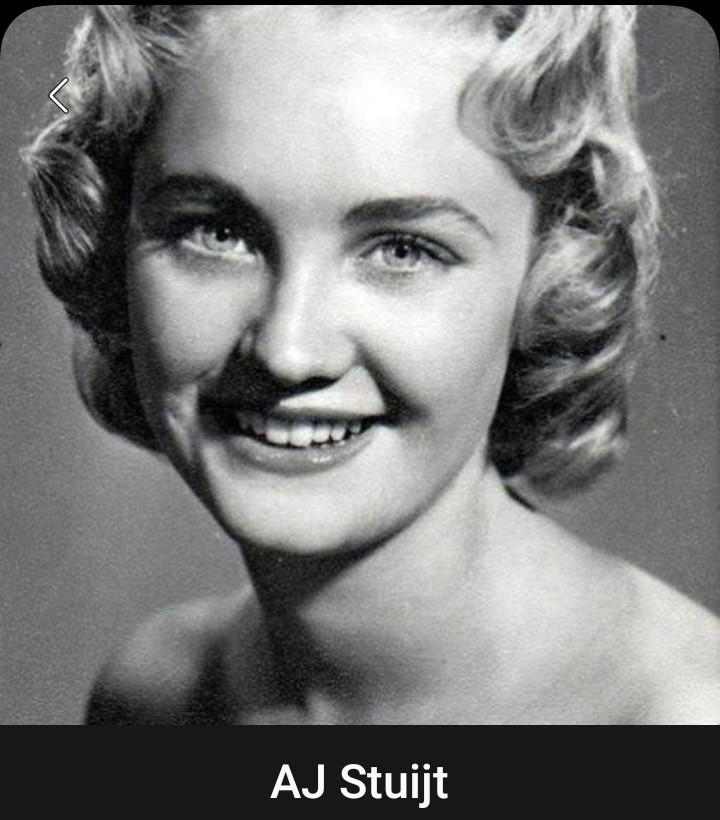
Adriana was born in the Netherlands and moved to South Africa, where she spent much of her adult life. You are correct about her background in pageantry; she was a former beauty queen and participated in Miss Holland in the early 1960s (notably competing in 1961), which served as a springboard for her early public life.
Journalism Career
Rand Daily Mail (RDM): She worked as a journalist for the Rand Daily Mail in Johannesburg during the apartheid era. While the paper was famously left-leaning and anti-apartheid, Stuijt worked as a medical journalist, focusing on health issues before her political views shifted significantly.
Later Career: After leaving the RDM, she continued to work as a freelance journalist and was involved in various media projects, including a stint in Zimbabwe.
Marriages and Family
Robert van Tonder: She was the second wife of Robert van Tonder, the founder of the Boerestaat Party and a prominent advocate for an independent Boer state. Van Tonder passed away in 1999.
Children: Robert van Tonder had six children. While historical records confirm Adriana as his second wife living with him on their farm west of Johannesburg, it is often noted that several of those children were from Robert's first marriage. Specific public records regarding how many of the six were biologically Adriana's are sparse, as she maintained a degree of privacy regarding her immediate family compared to her public activism.
Second Marriage: Following Van Tonder's death, she married a press photographer named Pierre Oosthuysen. The couple moved to the Netherlands in the early 1990s. Oosthuysen passed away in 2002.
Censorbugbear and Activism
In her later years, Stuijt became a polarizing figure through her digital activism:
Website: She founded Censorbugbear.org (and also operated Journalism Under Apartheid).
Focus: The site focused heavily on reporting farm attacks and murders in South Africa. She became a primary architect of the narrative that white farmers were targets of a systematic campaign, which she frequently characterized as a "white genocide."
Controversy: Her work was often criticized by contemporary researchers (such as Nechama Brodie) for using "hyperbolic" language and, in some cases, presenting unverified statistics. However, she remained a hero to some in the right-wing and "Boerestaat" movements.
Final Years
Adriana spent her final years in the Netherlands, where she continued to manage her website and social media presence, remaining active in South African political discourse from abroad until her death.